Insomnia Log

This is what keeps me awake at night???

Who needs sleep? (well you’re never gonna get it)
Who needs sleep? (tell me what’s that for)
Who needs sleep? (be happy with what you’re getting,
There’s a guy who’s been awake since the second world war)

-- words and music by Steven Page & Ed Robertson

Name:
Location: Boulder, Colorado, United States

Everything you need to know about me can be found in my posts

Sunday, September 25, 2011

Patent Reform is Bust for Brainy Boulderites

Last year Boulder was judged the brainiest city by Portfolio.com, but lumped in with 20th place Denver in Forbes' list of innovative cities.

Now we're seventh on the Insomnia Log Patent Friendly Cities list. Boulder area residents were issued 834 patents per 100,000 residents from 2006 through 2010, and only six other metro regions did better.

President Obama just signed a patent reform law, the first major overhaul of our patent system in 60 years, and there was hardly a peep from local inventors.

The most debated part of the new law converts the U.S. from a first-to-invent to a first-to-file system. Previously, you could get a patent if you could prove that you invented something first, even if someone else beat you to the Patent and Trademark Office. No more.

Supporters, including many of the biggest technology companies, say this will simplify things, eliminating contests over who actually owns an invention. A class of procedures is eliminated from the PTO. This should reduce legal costs, and help reduce the multi-year backlog of patent applications.

Many small inventors are not so thrilled. They fear big companies with teams of lawyers will file applications faster, and earn patents even when they weren't the first to come up with an idea.


[more]

Correction: In this essay, I said that, "Under the new law the PTO gets to keep all of its fees, rather than having them siphoned into the general fund." In fact, that provision was deleted during congressional negotiations.

Labels: , , , , ,

Tuesday, September 20, 2011

Patent Friendly Cities

These are the top 20 metropolitan areas in the US, based on the number of patents granted to residents per capita. This is based on the first named inventor on patents granted by the US Patent and Trademark Office from 2006 through 2010.
RankCity/RegionPatents/100,000
1San Jose-Sunnyvale-Santa Clara, CA2,202
2Corvallis, OR1,586
3Burlington-South Burlington, VT992
4Rochester, MN962
5Boise City-Nampa, ID906
6Bremerton-Silverdale, WA841
7Boulder, CO834
8Santa Cruz-Watsonville, CA758
9Austin-Round Rock-San Marcos, TX597
10Ann Arbor, MI591
11Fort Collins-Loveland, CO591
12San Francisco-Oakland-Fremont, CA564
13Rochester, NY496
14Poughkeepsie-Newburgh-Middletown, NY463
15Ithaca, NY458
16Seattle-Tacoma-Bellevue, WA427
17Raleigh-Cary, NC423
18Trenton-Ewing, NJ423
19Durham-Chapel Hill, NC390
20Boston-Cambridge-Quincy, MA-NH374

Labels: , , , ,

Tuesday, December 22, 2009

The Purity of Science

The level of smugness rising from the anti-global-warming blogosphere is reaching the level they accuse us environmentalists of exhibiting.

The bloggers who cry "hoax" have stumbled upon (some say stolen) a steaming pile of e-mails and files they claim proves there is a conspiracy by scientists to fudge the data and silence dissent.

[more]

Labels: , , , , , ,

Tuesday, November 25, 2008

Crunching the Global Warming Numbers

Anybody who reads me regularly knows that I'm kind of a nerd, and also knows that I'm very interested in the issue of global warming. So, you won't be surprised to know that I've found all the raw data I can get my hands on, and loaded it into Excel to play with.

Yes, there's nothing like just looking at a set of data, drawing graphs, comparing one thing to another, just rolling around in it. Sometimes when you're off doing something else, like maybe a long run, an idea jumps out at you, some way of making sense of all the numbers.

One thing I found when comparing the levels of CO2 in the atmosphere to the average annual global surface temperature is that there is strong mathematical correlation between the two. Correlation doesn't necessarily mean causation. But what I found is that the strongest correlation (88.3% correlation) is between CO2 level in one year and temperature 14 years later. That not only gives us one more piece of evidence that one is a causal factor in the other, but it also gives us a time frame. When you burn a gallon of gasoline in your car, you are impacting the future climate of the planet. And that impact may be felt immediately and may last for decades, but the strongest impact is about a decade and a half in the future.

What does this mean? Well, for one thing, even if we stop burning fossil fuels today we will still be seeing the impact for a while. But it also means that our actions today will have an impact within the foreseeable future. The impact of burning a gallon of gasoline today on the climate twenty years hence falls to the same level as its influence on this year's climate. So, if we can get our fossil fuel burning under control, perhaps in twenty years we will start seeing a significant difference.

What else did I see in the data? Here's one: Right at the time of World War II CO2 levels in the atmosphere stabilized, and even fell a tiny bit. From 1939 to 1948, there was essentially no change in CO2 in the atmosphere.

Why? I'm not sure, but perhaps the level of industry was reduced, and gas shortages caused reductions in driving, and that may have been enough to get our CO2 emissions to a reasonable level.

What happened with global temperatures then? Well, as you might guess, they stabilized or fell immediately after WWII. Between 1946 and 1957, global temperatures fell by about 0.12 degrees C. Temperatures didn't really start rising again until the 1970s, about 20 years after the CO2 levels started really rising again.

What can we learn from this? Well the most positive thing I take from this is a confirmation that not only do temperatures go up when CO2 goes up, but temperatures go down when CO2 goes down. Plus, we have a concrete example of mankind actually influencing global warming in the correct (lower) direction. This tells me that if we reduce our CO2 output to a level at which its atmospheric concentration is stable, we might, just might, be able to get the temperature increases under control.

Of course, our annual CO2 increase today is about five times as high as the annual increases in the 50s, so it won't be easy to get it under control. Much more of the CO2 is being originated in places that aren't the U.S., so there needs to be a truly global attack on the problem.

But at least it seems technically feasible.

Labels: , , ,

Thursday, December 20, 2007

Obama is Greater than McCain

Senator Barack Obama recently had a job interview, I mean spoke, at Google, hoping to impress the nerd crowd. And, just like he did previously with Senator McCain, CEO Eric Schmidt asked a trick technical question, although slightly differently this time. No doubt he read my criticisms of his earlier question and tried to tune it up a bit.

As I wrote, McCain lost a good opportunity to profit off his version of the question, "How do you determine good ways of sorting 1 million 32-bit integers in two megabytes of RAM?" He merely laughed it off. But, when Obama was asked for "the most efficient way to sort a million 32-bit integers", he actually made a reasonable but incomplete answer, "I think the bubble sort would be the wrong way to go."

Of course, Obama must have read my earlier blog post and knew that a question like this might be asked. He probably also prepared his answer in advance. But still, he didn't actually answer the question, he merely listed one incorrect answer.

So, what is the right answer. Well, Schmidt again didn't define all his terms. Primarily he didn't say what he meant by "efficient".

Well, to me, efficient means it takes me the least amount of time. So, if I were to be asked this question, the answer would obviously be, load the numbers into Excel and select the Data Sort menu option.

But that is probably not the right answer for candidate Obama. It would depend on exactly what the numbers are and why they needed to be sorted, but in most cases the best method would be to tell one of his interns to sort the numbers and come back with just the top three.

By the way, in my earlier post I said:
Full disclosure. This log is hosted by Blogger, which is owned by Google. So, if this post never shows up in any Google searches, I think I'll know why.
Well, it turns out that there was a huge spike in the number of people visiting my blog with search terms related to sorting of integers right around the time of Obama's interview. This can only mean that the folks at Google are using my blog to help them write better interview questions.

Does this mean I get a cut of the referral bonus?

And, Mayor Giuliani, are you paying attention?

Labels: , , , ,

Tuesday, May 08, 2007

What Sort of Sort?

I've heard that interviews at Google are tough. In fact, Senator John McCain was recently interviewed at Google, and he was indeed stumped by the opening question, which was about as geeky as you can imagine.

Google CEO Eric Schmidt asked "How do you determine good ways of sorting 1 million 32-bit integers in two megabytes of RAM?" McCain laughed it off as good natured fun at his expense. However, he missed out on a great opportunity to show those Googlers that they're not as smart as they would have us believe they are.

[Full disclosure. This log is hosted by Blogger, which is owned by Google. So, if this post never shows up in any Google searches, I think I'll know why.]

Oh, but if I were John McCain. Perhaps his days as a Vietnam POW softened him up to the vagaries of badly worded questions. The first thing I would say is, Eric, I would expect you, as the leader of one of the biggest computing companies in the world, to at least be able to ask a non-ambiguous question.

Do you mean, how would I find some ways that are good for sorting said integers in said limited memory platform? Or did you mean how would I decide on the goodness among various presented algorithms for sorting under these conditions? And, whatever do you mean by "good"? Do you mean the fastest? Least disk thrashing? Fewest license fees? Or, are you asking for my definition of good? When you say I get 2 megabytes of RAM, I guessing you'll also give me some disk space, and perhaps a bit of extra memory to put my hypothetical code into. Or maybe my code will fit in the space differential between two megabytes and two million bytes (almost 95K).

Suppose good old Eric laughed at my friendly jab, and clarified his question. Don't you think that the correct answer to the question would be, well, given that my college textbooks are long gone, along with all the textbook sorting algorithms therein, my first shot at finding a good algorithm would be, what else, Google. As in, type "memory constrained sorting algorithm" into my Google toolbar and see where it takes me. What do you want to bet it would take me straight to Wikipedia, and a catalog of all popular sorting algorithms?

What would I find there? Not sure. But I'm going to guess that my best bet for a fast sort would be to throw the first half of the integers into my limited memory and sort them using whatever fast sort is in fashion these days and save them, throw the second half into the same memory and sort them similarly, and then merge the two sorted lists.

Or perhaps I'd try something cute (in a geeky cute kind of way). I'd sort only the upper 16 bits of each integer. Then when I was done I'd only have to re-sort the small subset in which the upper 2 bytes were the same. Maybe I'd get a win there, but probably I'd just waste alot of time trying to figure it out.

So, how would I determine the goodness of the algorithms I came up with? Well, classically I'd count how many loops and nested loops there were, and use that to figure out how well they scale up. But since I have a very specific problem to solve (one file of one million numbers, two megabytes of memory), I'd really only have to know one measurement. I'd probably end up creating an Excel spreadsheet, put in 200 numbers, 2,000 numbers, 20,000 numbers. Then I'd write some freaky-looking set of formulas that implement my kooky algorithm and get out my stopwatch.

But only if I were a geek.

Senator McCain, any thoughts?

Labels: , , ,

Wednesday, May 03, 2006

He Killed Sudoku! You Bastard!

I don't usually write about myself in this forum. After all, a blog is not supposed to be about yourself, it's supposed to be about what you think about everybody else. And everything you need to know about me you should be able to learn by reading between the lines of my posts.

But here's something you need to know. I'm a bit obsessive. I don't do anything half way.

A while back, I started noticing this new type of puzzle in the daily newspaper, called sudoku. I tried one and eventually figured it out.

Well, it turns out that there are some rules you can follow and come up with the solution to any but the most difficult of these puzzles. I would find myself doing the puzzle and getting bored because it was becoming mechanical. Not to mention my hands getting tired from writing and erasing all those numbers.

Unsolved SudokuThen my wife bought me a book of sudoku puzzles. I didn't want to write all over the book (see, you're learning all kinds of things about me), so I thought of putting the puzzle on my computer. My sore hands were feeling better all the time.

Ready to SolveThe next thing I knew, I was creating an Excel spreadsheet to do the mechanical parts of solving the puzzle. I was writing little procedures to perform each of the little rules I'd come up with.

The Easy StuffWell, it happened. I ended up with a spreadsheet on which I could enter the original set of numbers, click a button, and after a while (maybe 20 seconds for an easy puzzle, another 2 minutes for the really hard ones) the solution would be presented to me.

All Done!So here's the dilemma. Solving the puzzle is just not fun anymore and it's not a challenge. I knew this would happen before I started, but I did it anyway. Ok, it's kind of cool watching the numbers fill in automatically. But I'm getting impatient.

I know, maybe I need a faster computer, so I can solve sudoku puzzles in just a few seconds. Yeah, that'll do it. I think I'll order one tomorrow.

Labels: , ,

Saturday, January 21, 2006

Speed Matters

Last Sunday, the Stardust spacecraft returned from its mission to collect dust particles from a comet. After the fastest return ever of a man-made probe, 29,000 mph, it successfully landed and was recovered, revealing even more cosmic dust than was hoped for.

Thursday, the New Horizons spacecraft took off for Pluto and regions beyond. It was accelerated to 36,000 mph, the fastest ever launch, and is expected to reach 47,000 mph during its journey as it picks up a boost from Jupiter. Eventually, it will get a close-up look at regions of our solar system we have only the dimmest images of.

Here's the lesson: Don't be shy. Get out there are give it all you've got. The harder you go, the bigger the rewards. And, it's damn impressive, too!

Labels: ,

Wednesday, January 11, 2006

Jobs Does It Again!

FROM THE FLOOR OF MACWORLD IN SAN FRANCISCO: Yes, literally from the floor of Macworld. After Steve Jobs' keynote speech, I had to pick myself up and quickly brush off all the dandruff flakes.

Yeah, yeah, everybody's gonna be talking about the Intel announcement, and the entrance Intel's Otellini made. They're gonna be talking about the powerful new MacBook. But, what really got me was the announcement of the new iPod Mega.

Think about it. They had us going for a while with the smaller is better. Nano this, pico that. But this is pure genius. Big is truly beautiful.

The iPod Mega does it all. Imagine a portable device that supports widescreen high-definition video, and a screen that you'll want to watch it on. It connects to your cable system, your DirecTv or Dish. It has a built-in DVR, with half a gig of disk space. The dual tuner model will probably be out within 8 months. 6.1 channel Dolby Digital sound. Wireless network with full Internet access. DVD/CD player (DVD writer model expected within a year). PDA/phone/4 Mpx camera.

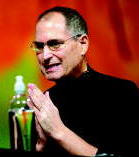
Steve Jobs at Macworld 2006, praying to his water bottle that his iPod Mega demo will work correctly.


Imagine getting on the bus, plane or train with one of these babies. You hang the HD monitor from the ceiling (hook provided), spread out the speakers in the other seats in your row, and just relax for the long ride home. The other passengers will be drooling!

Or, you're sitting in your cube at work. Nobody need be the wiser. The speakers are perfectly designed to fit on your bookshelf and in your filing cabinet, while the monitor can sit right in front of your computer monitor. Your boss walks by, and you just push a button. Magically, your HD movie is paused and your spreadsheet pops up on your iPod Mega monitor. Yes, that spreadsheet is real -- Apple has a deal with Microsoft to run MS Office on the Mega! And, with wireless networking, it may even be the one the boss just emailed you.

As you can see, I'm pretty psyched about this new product. There is even a special carrying case, complete with hand truck and backpack components. So, get with it, get your Mega, get to the gym and work on your back exercises. Because this is it!

Labels: , ,