Insomnia Log

This is what keeps me awake at night???

Who needs sleep? (well you’re never gonna get it)
Who needs sleep? (tell me what’s that for)
Who needs sleep? (be happy with what you’re getting,
There’s a guy who’s been awake since the second world war)

-- words and music by Steven Page & Ed Robertson

Name:
Location: Boulder, Colorado, United States

Everything you need to know about me can be found in my posts

Sunday, September 25, 2011

Patent Reform is Bust for Brainy Boulderites

Last year Boulder was judged the brainiest city by Portfolio.com, but lumped in with 20th place Denver in Forbes' list of innovative cities.

Now we're seventh on the Insomnia Log Patent Friendly Cities list. Boulder area residents were issued 834 patents per 100,000 residents from 2006 through 2010, and only six other metro regions did better.

President Obama just signed a patent reform law, the first major overhaul of our patent system in 60 years, and there was hardly a peep from local inventors.

The most debated part of the new law converts the U.S. from a first-to-invent to a first-to-file system. Previously, you could get a patent if you could prove that you invented something first, even if someone else beat you to the Patent and Trademark Office. No more.

Supporters, including many of the biggest technology companies, say this will simplify things, eliminating contests over who actually owns an invention. A class of procedures is eliminated from the PTO. This should reduce legal costs, and help reduce the multi-year backlog of patent applications.

Many small inventors are not so thrilled. They fear big companies with teams of lawyers will file applications faster, and earn patents even when they weren't the first to come up with an idea.


[more]

Correction: In this essay, I said that, "Under the new law the PTO gets to keep all of its fees, rather than having them siphoned into the general fund." In fact, that provision was deleted during congressional negotiations.

Labels: , , , , ,

Tuesday, September 20, 2011

Patent Friendly Cities

These are the top 20 metropolitan areas in the US, based on the number of patents granted to residents per capita. This is based on the first named inventor on patents granted by the US Patent and Trademark Office from 2006 through 2010.
RankCity/RegionPatents/100,000
1San Jose-Sunnyvale-Santa Clara, CA2,202
2Corvallis, OR1,586
3Burlington-South Burlington, VT992
4Rochester, MN962
5Boise City-Nampa, ID906
6Bremerton-Silverdale, WA841
7Boulder, CO834
8Santa Cruz-Watsonville, CA758
9Austin-Round Rock-San Marcos, TX597
10Ann Arbor, MI591
11Fort Collins-Loveland, CO591
12San Francisco-Oakland-Fremont, CA564
13Rochester, NY496
14Poughkeepsie-Newburgh-Middletown, NY463
15Ithaca, NY458
16Seattle-Tacoma-Bellevue, WA427
17Raleigh-Cary, NC423
18Trenton-Ewing, NJ423
19Durham-Chapel Hill, NC390
20Boston-Cambridge-Quincy, MA-NH374

Labels: , , , ,

Sunday, March 27, 2011

First Lucky Island

One thing seems evident when looking at the nuclear crisis at Fukushima Dai-Ichi (literally, Fortunate Island Number One, not to be confused with Three Mile Island).

If you are a fan of nuclear energy, that one thing is that even after one of the biggest earthquakes ever followed by a huge tsunami, the worst case scenario didn't happen. Nuclear is even more good-to-go than before.

If you are a nuclear foe, then what happened in Japan proves how dangerous this technology is. It is only pure luck and seat-of-the-pants management that prevented a complete meltdown and huge nuclear disaster.

I look at things differently.


[more]

Labels: , , , , , ,

Wednesday, December 29, 2010

Actors in the New Security Theater

According to one rumor, former Idaho Senator Larry Craig originally recommended the recent changes in airport screening processes. Perhaps now he won't have to go to the airport men's room to satisfy his alleged needs.

Craig's self-reported "wide stance" may prove useful in the new full-body scanners. However, he might opt out in favor of the enhanced pat-down, maybe even requesting that it be performed in a private room.

I can't fully report in this family publication, but many refer online to the scanners based on their ability to determine the size of parts of the anatomy commonly shielded from view, and to the pat-downs using the name of a location on a baseball diamond.

The resistance to the new procedures is widespread among some travelers. No wonder: you stand with your legs spread wide, and someone runs his or her hand up your leg until "meeting resistance."

Many others are stoically accepting the changes.

But is there a third group, people who actually enjoy the sanctioned public exhibitionism and groping?


[more]

Labels: , , , , , , ,

Sunday, October 10, 2010

The Brighter Side

Nine years have passed since the 9/11 terrorist attacks. I remember that day as clearly as yesterday, as I'm sure many of you do.

There was the phone call telling me to turn on the television, and then the disbelief, the shock, the grief as I watched buildings with thousands of people inside crumble and collapse to the ground.

What I and millions of other people wanted was information. But there were few sources, and nothing could be done by those of us on the sidelines.

Out of respect I hesitate to compare the Fourmile fire to the 9/11 attacks. But there are some parallels.

Communication technology, both successful and failed, was a significant part of the 9/11 story. We'll never forget the final phone calls from the hijack and tower victims, the loss of the network broadcast towers when the North Tower collapsed, or the overloading of the cell networks.

[more]

Labels: , , , , , , ,

Saturday, March 06, 2010

Safe, Clean Nuclear Power

To create more of these clean energy jobs, we need more production, more efficiency, more incentives. And that means building a new generation of safe, clean nuclear power plants in this country. - President Barack Obama, 2010 State of the Union Address
Many environmentalists gasped when the President made this comment. We all know that nuclear power is neither safe nor clean.

Nuclear reactors are dangerous. They are subject to meltdown. They are targets for terrorists. Nuclear fuel is a safety problem from mining though transportation, and there is not nearly enough uranium available for widespread use of nuclear power. Nuclear waste is dangerous in even small quantities: There is no safe storage option, and it remains unsafe for thousands of years.

Plus, huge amounts of greenhouse gases are produced in the mining, enriching, and transport of uranium; the building and decommissioning of the plants; and the transportation of nuclear waste.

But what if these dangers and problems didn`t exist?

[more]

Labels: , , , , , , ,

Sunday, December 28, 2008

The Only Way to Stop Global Warming?

I write quite a few essays about global warming. These include several ideas on how individuals can help address the problem. But I'm not naive enough to think that even a significant minority of well-intentioned consumers doing what they think is right will have a measurable impact.

Some of my Libertarian-leaning friends say that the solution should be left to the free market. (At least they are mostly agreeing that the problem is real.) But here's the problem with that. Given enough time (say, 100,000 years), the free market will arrive at a solution. But in the meantime, lots of people and species will suffer, and most of them are not directly related to the companies and individuals causing the biggest impacts. You see, the flaw in this thinking is that spewing greenhouse gases into the atmosphere is definitely impinging on others' rights, and the free market should not allow individuals or companies to infringe on the rights of others in the name of profit, even if those others are not yet even born.

One politically popular approach is cap and trade (carbon trading). Here, companies are issued the right to emit a certain amount of greenhouse gases. If they emit more, they have to purchase the right to do so from someone else. If they emit less (or if they remove carbon from the atmosphere), then they can sell the credits.

The problem with cap and trade is that it assumes people and companies have the inherent right to put greenhouse gases into the atmosphere, impacting future generations around the globe. That would be like saying that, since there are 16,000 murders per year in this country, we are going to cap and trade permits to kill people. The permits will be issued proportionally to the number of murders you committed last year. If you kill more people next year, you will have to buy more permits from someone who came in under their cap. (Have no fear, each year we will cut the number of permits issued. By the year 2050 we will only be allowing 10,000 murders per year -- uh, subject to change based on input from organized crime's lobbyists.)

I've always thought that a carbon tax (actually a tax on any greenhouse gas emissions) is the ideologically best way to approach the problem. You charge a tax for any fossil fuel burned. It can be charged when the fossil fuels are mined, when they are burned, or any point along the supply line, but we would need to be consistent so they are charged exactly once.

You may ask, what about other countries? This will have no impact on China, India, or any other part of the world that may be contributing significantly to the problem.

I have two answers to that. First, we slap a tariff on all imported goods and services, proportional to the amount of greenhouse gases used to produce and ship to the U.S. If the producer can provide proof that they have an equivalent tax in their home country, this tariff will be waived. And second, if this program is successful, it can provide a model for other countries, and a useful tool in negotiating international agreements.

There's one more big problem with a carbon tax, and this is where I got stuck. Such a tax is highly regressive. The people who will suffer the most are those that already can't afford the gas to drive to work and the energy to heat their homes.

I pondered this last issue long and hard until I ran across this idea from Jim Hansen. Dr. James Hansen is none other than the scientist who first brought climate change to the attention of the U.S. Congress in the 1980s, and he continues to be active in the field.

Dr. Hansen suggests (actually demands) a carbon tax, but he adds a twist: 100% of the revenue of the tax is refunded immediately to the citizens. People would receive monthly direct deposits into their bank accounts. None of the received new tax money would be spent by the government. Instead the money would be divided equally among every man, woman and child.

How does that work? Say this new tax causes massive inflation (after all, the companies paying the tax will just pass it on to consumers). People might be paying $1,000 more per month for home heating, electricity, gasoline, and goods and services produced using these resources. But, the same people would be seeing the same $1,000 appear like magic, like clockwork every month.

If I'm a smart consumer, I'm going to figure out how to cut back on my energy usage and set aside some of that new money to make my home more energy efficient, or buy a plug-in hybrid, or any number of investments designed to allow me to live more efficiently and hence spend less money.

And, if I'm a smart business, I'm going to figure out how to get some of that new money. I'm going to start selling some of those energy-efficient products. And it won't be something goofy like carbon credits. Instead it will be something that will actually cause less greenhouse gas emission.

How much money are we talking about? Well, one estimate was that it would take an investment of about $100 per ton of carbon dioxide to stabilize greenhouse gas emissions by 2030. Each person in the U.S. emits about 22 tons of CO2 per year. So, we're talking about new taxes (and new dividend checks) of about $200 per month per person, or $800 for a family of four. Most of the cost for the typical family, I assume, would be in the form of higher prices for energy, and for good and services produced using fossil fuels. That cost would be offset by direct deposit of an approximately equal amount each month.

Of course, we'd need a scientific panel to determine the correct amount of the new tax for each product or service, as this should not be a political decision. And we would likely want to phase this tax in over a small number of years.

Is this the best solution? I don't know. But it seems to me that we need to be thinking about radical ideas such as this, instead of relying on do-gooders, relying on the free market, or relying on the ability of politicians to solve this in a timely manner. Because a timely manner is the thing that is most important.

Labels: , , , , , , , , ,

Tuesday, November 25, 2008

Crunching the Global Warming Numbers

Anybody who reads me regularly knows that I'm kind of a nerd, and also knows that I'm very interested in the issue of global warming. So, you won't be surprised to know that I've found all the raw data I can get my hands on, and loaded it into Excel to play with.

Yes, there's nothing like just looking at a set of data, drawing graphs, comparing one thing to another, just rolling around in it. Sometimes when you're off doing something else, like maybe a long run, an idea jumps out at you, some way of making sense of all the numbers.

One thing I found when comparing the levels of CO2 in the atmosphere to the average annual global surface temperature is that there is strong mathematical correlation between the two. Correlation doesn't necessarily mean causation. But what I found is that the strongest correlation (88.3% correlation) is between CO2 level in one year and temperature 14 years later. That not only gives us one more piece of evidence that one is a causal factor in the other, but it also gives us a time frame. When you burn a gallon of gasoline in your car, you are impacting the future climate of the planet. And that impact may be felt immediately and may last for decades, but the strongest impact is about a decade and a half in the future.

What does this mean? Well, for one thing, even if we stop burning fossil fuels today we will still be seeing the impact for a while. But it also means that our actions today will have an impact within the foreseeable future. The impact of burning a gallon of gasoline today on the climate twenty years hence falls to the same level as its influence on this year's climate. So, if we can get our fossil fuel burning under control, perhaps in twenty years we will start seeing a significant difference.

What else did I see in the data? Here's one: Right at the time of World War II CO2 levels in the atmosphere stabilized, and even fell a tiny bit. From 1939 to 1948, there was essentially no change in CO2 in the atmosphere.

Why? I'm not sure, but perhaps the level of industry was reduced, and gas shortages caused reductions in driving, and that may have been enough to get our CO2 emissions to a reasonable level.

What happened with global temperatures then? Well, as you might guess, they stabilized or fell immediately after WWII. Between 1946 and 1957, global temperatures fell by about 0.12 degrees C. Temperatures didn't really start rising again until the 1970s, about 20 years after the CO2 levels started really rising again.

What can we learn from this? Well the most positive thing I take from this is a confirmation that not only do temperatures go up when CO2 goes up, but temperatures go down when CO2 goes down. Plus, we have a concrete example of mankind actually influencing global warming in the correct (lower) direction. This tells me that if we reduce our CO2 output to a level at which its atmospheric concentration is stable, we might, just might, be able to get the temperature increases under control.

Of course, our annual CO2 increase today is about five times as high as the annual increases in the 50s, so it won't be easy to get it under control. Much more of the CO2 is being originated in places that aren't the U.S., so there needs to be a truly global attack on the problem.

But at least it seems technically feasible.

Labels: , , ,

Wednesday, August 20, 2008

Yes, It's Getting Hotter, and, Yes, It's Our Fault

I know it's been a while since I last posted. I guess I can blame it on, first, the Tour de France, and second, the Olympics. But now that the coverage of any of the sports I'm interested in ends for the year, I once again can devote my insomniac hours to my rants here.

I thought since it's been a while I should take on a weighty subject. So, I decided I would try to prove global warming. If you read this site regularly, you know that this topic is on my mind quite a bit. And, nothing irritates me more than people who dismiss the idea of global warming as nothing more than some kind of conspiracy, a way for Al Gore to get rich and for scientists to get research dollars.

Specifically, I'm talking about "anthropogenic global warming (affectionately referred to as AGW), also called climate change. "Anthropogenic" means caused by humans. Global refers to the fact that the changes span every part of our planet. Some places may get warmer, some colder, some rainier, some drier. Climate is not the same as weather, meaning that one hot spell, cold spell, hurricane, temperature record, or any other anomaly doesn't prove things one way or the other. But on the average things are getting warmer.

Follow along carefully. The science isn't that hard. You can get more details on any of this from Wikipedia or your other favorite reference. The math is very straightforward. I used Excel.
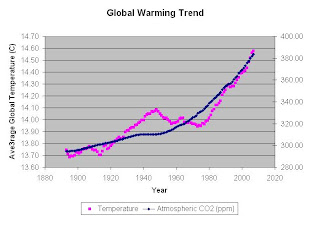
This chart shows the basis of the argument. It shows the rise in carbon dioxide in the atmosphere since just before the start of the twentieth century, along with the average global temperature in the same time period. Note that I average temperatures over an 11 year period, because that is the sun spot cycle and I wanted to remove influence from that. You can see that temperatures rose sharply at the beginning of the century, up until about World War II, fell for several years, and then resumed an even more steep rise, through today (actually, 2007, which is the latest year for which there is complete data). There has been about a 0.8 degree C rise over this period.

Is this significant? Well, since human civilization evolved, the average temperature of this planet has hovered within a range of about a degree, and we are now at the high end of that range with temperatures still rising. The eight highest global temperatures on record were recorded in the last ten years (1998-2007). Not only are temperatures rising, the rate at which they are rising is going up -- the change is accelerating.

So, global warming is real. But how do we know that it is caused by humans?

Well, look at the second line in the graph, the amount of CO2 in the atmosphere each year. This has gone up every year (except for a brief respite around World War II) since the start of the industrial revolution, when humans starting burning fossil fuels. Prior to that, CO2 levels were pretty much constant from year to year.

Ok, so CO2 has gone up. But is there any proof that humans are responsible for this, and how do we know that this is where the temperature rise comes from?

There are actually several ways to show that humans are responsible for the rise in CO2. The most obvious is the time coincidence. The level was constant prior to the mass release of carbon from under the earth into the air. Then it started going up, with the rate of increase going up as people starting burning more fossil fuels. The second piece of evidence is the spatial coincidence. Measurements of CO2 levels have gone up most in parts of the earth where more fossil fuels are burned (e.g., in the northern hemisphere vs. the southern).

But there is a more direct way of measuring the human responsibility for CO2. See, a percentage of carbon in the biosphere is a radioactive form, C-14. But carbon in fossil fuels has been buried deep in the earth so long that the C-14 has decayed. By measuring the amount of C-14 in tree rings, scientists can determine the portion of carbon that came from fossil fuels each year, and that amount has gone up steadily as the CO2 has gone up.

Ok, we're almost there. Temperatures are definitely rising, CO2 has risen along with the temperatures, and humans are responsible for the CO2. Can we prove that the CO2 is responsible for the warming?

To start, let's look at something called the "greenhouse effect". This is caused by a quantum mechanical effect that happens when certain gases (CO2 among them) are struck by infrared (IR) radiation at certain frequencies. It causes energy to be released in all directions. If the IR radiation happens to be heat reflecting off the surface of the earth from solar radiation, some of that energy continues up while some is reflected back to the earth, warming the surface. At a certain temperature increase, the amount of heat going up equals the amount going down, and the temperature reaches a balance.

Currently, that balance point is about 32-33 degrees C above the nominal temperature on this planet. Without the greenhouse effect, the average temperatures would be 32 degrees C (58 degrees F) colder, and life would probably not exist.

There are several gases that contribute to the greenhouse effect. The largest contribution is from water vapor, H2O, which is not significantly affected by human activities. (Except that as the temperature rises the amount of H2O will also rise.) The second is CO2, which as we've seen has risen by about 35% due to human activities in the past 150 years. There are other greenhouse gases that are also affected by human activities, such as methane and chlorofluorocarbons (the latter of which does not occur naturally in the atmosphere).

To determine the relative impact of the various gases, experiments have been performed in which each gas has been removed and the reduction in greenhouse effect measured. Of course, it is not that simple, since the various gases interact and change the greenhouse effect by combination. So, the portion of the greenhouse effect attributable to CO2 is somewhere between 9% and 26%.

So, to do some simple math, CO2 is responsible for between 2.9 degrees C and 8.3 degrees C of the base global temperature. Another 35% on top of that would theoretically bring about a global warming effect of about 1.0-2.9 degrees C. In the real world, of course, it's not quite that simple. There are greenhouse gases other than CO2. There are other climate impact events, such as sunspots and volcanoes. And there is an expected lag time of a couple decades from when the CO2 is put into the atmosphere until when the corresponding temperature rise is seen.

And indeed we've seen a rise of about 0.8 degrees, pretty darn close to what we just predicted. Some of the CO2 warming hasn't been seen yet, and there are other climate-impacting factors that have changed things over shorter spans (a few years). But the fact is, temperatures have gone up almost exactly in line with what is predicted based on the known science behind the greenhouse effect.

So, bottom line, we have shown that global warming is real. We've shown that atmospheric CO2 has gone up in line with the temperature increases, and that those CO2 increases are caused by human activities. And we've shown that the measured warming is exactly what is predicted based on the greenhouse effect.

For someone to dispute AGW, they would not only have to come up with an alternate explanation for why the earth has heated over the past 150 years, but they would also have explain what happened to the heat from the additional CO2. And nobody has done so.

So, global warming is real and caused by people. That still leaves two big questions -- what will the impacts be, and what should we do. There's still lots of room for discussion on both of these topics (and I'll be talking more about them in upcoming posts). But don't let anybody tell you that global warming itself is a hoax.

Labels: , , , , ,

Saturday, June 14, 2008

Improving kWm by kWm

I think and write quite a bit about climate change and the environment, and in our household we take environmental awareness quite seriously. We burn less natural gas, use less gasoline, use less water, and generate less garbage than most households in this country. So, when we found in an energy audit a few months back that our electrical usage was actually above average, we were quite embarrassed.

You see, we had already done most of the things you do to cut down your energy usage. All of our light bulbs are compact fluorescent. Our appliances have by and large been replaced with more efficient models as the time has come to retire the old ones. We don't use air conditioning. And we removed the jacuzzi tub in our yard. What was going on? Was someone breaking into our house in the middle of the night and plugging in high wattage floodlights?

Fortunately, the energy auditor gave us a couple of tips, so we had something to try. We've now gotten three bills since the audit, and I'm happy to report that our monthly usage, compared to last year, has gone down 13% (for the first, partial month), 14%, and 25% for the most recent month. Our electricity usage for the past month was likely the lowest it's been since we moved in several years ago. That's an incredible savings, and I feel like we did almost nothing to earn it.

What did we do? First we turned off a couple items of electronics that weren't being used, and put most of the rest on power strips. Want to watch TV? Just remember to flip on the power strip before you sit down, and flip it off again when you're done. Going to use the treadmill? There are two power strips you have to flip, one for the exercise equipment, and one for the entertainment equipment. And who wants to work out inside this time of year anyway?

Power strips are about $5 - $10 each. We actually had some lying around, so this cost us nothing. And once you get used to it, the amount of extra effort is almost nothing. This equipment now draws power a few hours per week maximum, rather than 24 hours every day. It adds up.

We also configured our computers to go into hibernate mode rather than running all the time. That's a bit of a bother, as it now takes a little longer to start up when you sit down.

One other thing. Our home computer has an Energy Star LCD flat panel display, but my work computer in my home office had a rather old CRT monitor. I asked my employer for a new monitor. An energy-efficient monitor can be purchased for about $150. The one my employee provided probably cost $200 or $250 new, but they happened to have one that wasn't being used, so there was no expense involved.

So, our savings came with no cost to us and very little inconvenience. If we had bought the power strips and a new monitor, we could have spent less than $200. Our June electric bill was more than $12 cheaper than our June bill last year. At that rate, the investment would have paid for itself in a little over a year.

We discovered that it's true that the little things add up. Kilowatt minutes can easily become kilowatt hours. Most electronic devices continues to draw power even when they are turned off, so the secret is finding those items that you don't use all the time and cutting power when you aren't using them. And make it easy to do so, so you really will do it.

Labels: , , , , , , ,

Thursday, January 17, 2008

Addicted to Snap

It's all my fault. The debacle in the New Hampshire primary is just one symptom of the problem, and I'm taking full blame.

What happened? It's actually pretty clear. The public pushed the media for more information quicker. We need to know the results of the election as soon as possible, ideally before the election. Cable news now has several full-time channels devoted to feeding our insatiable appetite to absorb more of what we want at a faster pace. If they can tell us ahead of time how the primary is going to end, then who needs the actual election? And at that point the rest of the process is equally irrelevant. They might as well just tell us who is going to win in November, so we can get on with the business of minding Britney's business.

The only problem with this equation is that they haven't figured out how to get the outcome right in advance. At least not yet. But don't worry, it won't stop them from continuing to do it. And believe me, they will get better. How? By figuring out how their reports affect us voters, and shaping their reports to make sure we do what they just told us we were going to do. You won't want to, but you really won't have a choice.

Why is this all my fault? Well, the way I see it, this is one minor symptom of a much larger cultural shift in our country, one that has been picking up speed in the last several years. It seems that we Americans want more, we want it faster, and we want it on our terms. Anything worth waiting for is not worth getting.

Look at some examples. We can't watch TV on its own timeline, so we get our TiVos and video-on-demand. Radio? Forget it -- give me an iPod. Crack open a book or go to a library? Give me a break, that's what the Internet is for. Even email is now too slow. And so on. Why do you think people drive to the gym or refuse to take the bus or ride their bikes to work. It's because every second of our short, pitiful lives is critical and can't be wasted.

But it's never enough. Each increase in speed of product and information only makes us more impatient. We can't wait for the next version that will bring us what we want while we're on the go, without waiting, and at higher and higher bandwidths. And I guarantee that the next generation won't quite cut it either. Or maybe for a couple weeks, until we see our coworker's new iPod Next that supports smell-o-vision and connects directly to the brain.

And I've worked my entire career on creating and putting to market those very products that ramp up consumers' expectations. I take responsibility, but I refuse to change. Because I'm just about as addicted as the next person. When I have to wait two seconds for the video to start, or when I can't update my blog while I'm in another country, or when I actually have to go to the store and walk around in order to buy stuff, I get that rush of adrenaline, that urge to punch my computer screen. This can't be happening to me. Why doesn't somebody do something about all these problems.

So I do. As do my brethren in the consumer-feeding-frenzy-fulfillment industry.

So, please, take a deep breath. If it took an extra second to load this page, realize that it's not my fault.

And when it comes your turn to vote for President, remember there is only one critical question to ask of the candidates: Where do you stand in the issue of providing iPhones to every American?

Labels: , , , , ,

Saturday, August 25, 2007

This Bad Idea Is Patently Obvious

This week, the US Patent and Trademark Office (PTO) issued new rules related to filing new patents and prosecuting them through the patent office on the way to being issued. These are hundreds of pages of new regulations that change the way things are done from start to finish in that process. It is designed to reduce the amount of work that the patent office does (pushing much of it onto the patent filers) and reduce the backlog, which in some case is five years or more until the patent office even looks at a case for the first time.

Now, many of my readers won't care about this topic, which is fine. Most people have no reason to think about the process by which an inventor can get a legal monopoly on a new invention. However, I care quite a bit. I filed my first patent application 15 years ago, and I now have about 50 issued US patents. I've dealt extensively with patent attorneys and directly with the PTO. I've come at it from the perspective of a large company, a small company, and an independent inventor. So, I think my opinion is not only valid but based on significant experience.

Fundamentally, the idea of trying to fix the patent application backlog is good. The PTO has been hiring 1,000 new examiners per year to try to catch up, and so far hasn't made too much of a dent. However, the new rules have a number of very basic flaws that need to be addressed to make them reasonable.
  1. The rules are being applied retroactively. This means that a case filed two years ago with no knowledge of these rules will still be treated under the new rules. It will still have all the same limitations. If us patent authors had known about these rules, we would have written the applications differently, but now it is too late to change them. In effect, the PTO is stealing some of the value of our intellectual property.
  2. Much of the patent examiner's work is being transferred to the applicant. Certainly, this will increase the cost and time to file a patent application. But, more importantly, if the examiner uses the applicant's work, it is giving too much power to the applicant to define the patentability of his or her own invention; and, if the examiner doesn't use the applicant's work, the cost of that work is wasted.
  3. The new rules are unfair to small inventors. A large company can adjust its budget, or can adjust the number of patents it files each year. An independent inventor, who used to be able to rely on the PTO examining the case and who also used to be able to defer some of the costs of determining the patent claims, now must spend all of that time and money up front. This is a huge hit to small-time innovation in this country.
  4. This change also works against the truly innovative patent applications. For many inventions that are relatively small improvements on existing ideas, the new limits on number of claims and number of continuations are not a big hit. However, if your patent application describes a brand new category of product in lots of detail, you may want to claim your invention in several different ways. It may also take a few years and several tries to fully define the most important ways that the case is truly innovative. With the new rules, what used to make great sense for the truly innovative independent inventor is now severely restricted. It may no longer be feasible for the small inventor to patent that once in a lifetime great idea.
I call on the PTO to go back to the drawing board on this. Change the rules, and, when you do so, you must not reduce the value of existing patent applications. You must not price small inventors out of the market. You must not allow inventors to determine the patentability of their own inventions. And you must not put up barriers to the most creative inventors in our country.

The US Constitution says:
Congress shall have power . . . To promote the progress of science and useful arts, by securing for limited times to authors and inventors the exclusive right to their respective writings and discoveries.
The PTO should not have the power to diminish that right.

Labels: , ,

Friday, March 09, 2007

Signs of Spring

What's the difference between insomnia and amnesia?

I can't remember. Can I just sleep on it?

I knew spring finally had to show up. The first sign is that the ice on our street has finally been reduced to a single snowball a block away, some puddles, and potholes too numerous to count.

Days are getting longer. And that can only mean one thing: My least favorite day of the year. That would, of course, be the first day of daylight saving time. That valuable lost hour of sleep won't be regained this year until November, leaving me further sleep deprived for a month longer than I'm used to.

The change in DST this year has caused some consternation among software folks all over. It seems like lazy programmers didn't account for the fact that the start and end day of DST might change. Kind of like a mini Y2K.

You'd think a big company like Microsoft would have this all figured out well in advance. But in my office we use Microsoft Outlook for all of our scheduling, and it just ain't so. A couple of days ago, we got an email from our IT guy, with an emergency patch from Microsoft that we were all supposed to run. This patch would supposedly fix all of our appointments so they would be scheduled correctly between the new start of DST and when it used to start three weeks later.

Well, the meeting update notices were flying through our email system, until we got another notice from IT warning us not to run the patch. The new instructions? Look at your calendar and see if your meetings are all scheduled at the right times. If not, change them manually.

I think I'll wait until Monday to do that. If the world happens to end due to the DST bug, I will have saved that effort.

What's up with daylight saving time, anyway? I'm pretty sure we don't actually save any daylight. We just give up an hour of sleep and have to get up earlier.

Congress passed the law to extend DST as a way to save energy. However, they forgot to take into account the fact that we will all have to turn on our lights in the morning when we get up, and will no doubt use most of the energy we save.

Do you think anybody would notice if I "forgot" to adjust my clocks, and just showed up an hour late to everything all summer?

Labels: , , ,

Wednesday, January 11, 2006

Jobs Does It Again!

FROM THE FLOOR OF MACWORLD IN SAN FRANCISCO: Yes, literally from the floor of Macworld. After Steve Jobs' keynote speech, I had to pick myself up and quickly brush off all the dandruff flakes.

Yeah, yeah, everybody's gonna be talking about the Intel announcement, and the entrance Intel's Otellini made. They're gonna be talking about the powerful new MacBook. But, what really got me was the announcement of the new iPod Mega.

Think about it. They had us going for a while with the smaller is better. Nano this, pico that. But this is pure genius. Big is truly beautiful.

The iPod Mega does it all. Imagine a portable device that supports widescreen high-definition video, and a screen that you'll want to watch it on. It connects to your cable system, your DirecTv or Dish. It has a built-in DVR, with half a gig of disk space. The dual tuner model will probably be out within 8 months. 6.1 channel Dolby Digital sound. Wireless network with full Internet access. DVD/CD player (DVD writer model expected within a year). PDA/phone/4 Mpx camera.

Steve Jobs at Macworld 2006, praying to his water bottle that his iPod Mega demo will work correctly.


Imagine getting on the bus, plane or train with one of these babies. You hang the HD monitor from the ceiling (hook provided), spread out the speakers in the other seats in your row, and just relax for the long ride home. The other passengers will be drooling!

Or, you're sitting in your cube at work. Nobody need be the wiser. The speakers are perfectly designed to fit on your bookshelf and in your filing cabinet, while the monitor can sit right in front of your computer monitor. Your boss walks by, and you just push a button. Magically, your HD movie is paused and your spreadsheet pops up on your iPod Mega monitor. Yes, that spreadsheet is real -- Apple has a deal with Microsoft to run MS Office on the Mega! And, with wireless networking, it may even be the one the boss just emailed you.

As you can see, I'm pretty psyched about this new product. There is even a special carrying case, complete with hand truck and backpack components. So, get with it, get your Mega, get to the gym and work on your back exercises. Because this is it!

Labels: , ,